IV hydration vs drinking water: if you need to feel better fast (after a hangover, illness, or intense heat), IV hydration can rehydrate you far more quickly and completely than simply sipping water, because fluids, electrolytes, and nutrients go straight into your bloodstream instead of waiting on digestion.
Key Takeaways
- IV fluid enters your bloodstream immediately with nearly 100% bioavailability; water takes 45–120 minutes to fully absorb.
- A 1-liter IV bag delivers the hydration effect of 8–10 glasses of water in 40–60 minutes.
- IV therapy replaces electrolytes and vitamins that plain water cannot provide.
When people compare IV hydration vs drinking water, they are really comparing two different hydration systems. Whether IV hydration is better than drinking water is not really a question of which one wins overall. It comes down to which one your body can actually use right now. In everyday life, drinking water is still the foundation of healthy hydration, while IV hydration is a targeted, higher‑intensity option for moments when your body needs rapid, precise support that a glass of water alone cannot provide.
1. Drinking Water Isn’t Always Enough
When dehydration hits fast, from a hangover, a stomach bug, intense heat, or hard exercise, the body needs to restore blood volume quickly. Drinking more water feels like the obvious answer. The problem is that the digestive system runs on a fixed timeline that no amount of willpower can accelerate.
Water does not enter your bloodstream the moment you swallow it. It travels through your esophagus and stomach before reaching the small intestine, where about 95% of absorption actually takes place. On an empty stomach, water begins entering the bloodstream within 5–20 minutes, but full distribution across all body tissues takes 75–120 minutes. Add food, nausea, or active illness, and that window stretches to 2 hours or beyond. A PMC pharmacokinetic study confirmed that complete equilibration across the body’s fluid compartments takes roughly 75–120 minutes even under normal conditions.
The body holds about 42 liters of water split across separate compartments: around 28 liters inside cells, 14 liters outside, and only about 3.5 liters circulating in the blood vessels. In acute dehydration, it is that small vascular compartment that needs urgent replenishment. Oral fluids address total body water over time, but they cannot quickly restore the circulating blood volume that blood pressure and organ function depend on.
Plain water also creates a second, less obvious problem. Because it contains no electrolytes, drinking large amounts without replacing sodium and other minerals can dilute the blood’s mineral balance. When sodium falls below 135 mmol/L, the result is hyponatremia, a condition that causes nausea, confusion, headache, and in severe cases, seizures or loss of consciousness. Research from the Gatorade Sports Science Institute confirms that athletes relying on plain water during prolonged activity face accelerated risk of this dilutional hyponatremia, precisely because water replenishes fluid volume without replacing the sodium lost in sweat.
2. What’s Actually Inside an IV Bag?
Most people assume the difference between IV fluids and drinking water is simply the delivery route. It goes much deeper than that. Understanding what actually goes into the bag is what explains why hydration IV fluids produce results that oral hydration simply cannot match.
The standard base is 0.9% normal saline, a sterile sodium chloride solution with an osmolarity close enough to blood plasma that it can be infused directly into a vein without causing cells to swell or collapse. Plain water cannot be given intravenously because it is hypotonic, meaning it would cause red blood cells to absorb water rapidly and rupture. IV fluid is a precisely engineered medical solution, not filtered tap water in a bag. An alternative base, Lactated Ringer’s solution, includes sodium, potassium, calcium, and lactate, making it a closer match to the body’s natural fluid composition and often preferred when electrolyte correction is the priority.
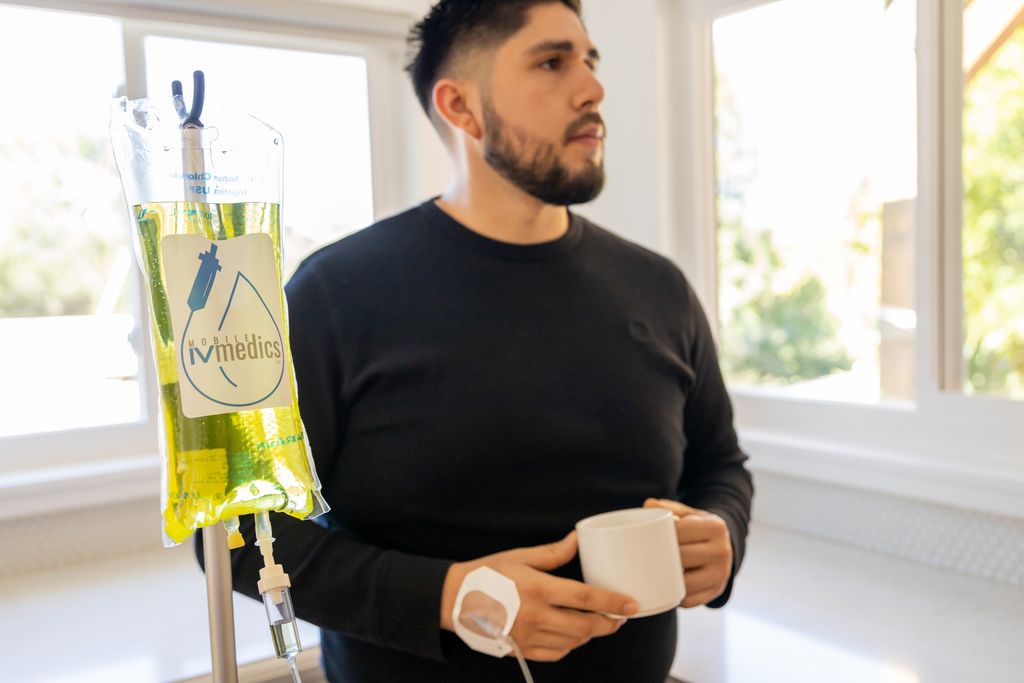
Beyond the base fluid, a Mobile IV Medics session can include electrolytes to restore sodium, potassium, magnesium, and calcium; B-complex vitamins that fuel energy production and are rapidly depleted by alcohol, illness, and stress; Vitamin C, which reaches plasma concentrations 10–50 times higher when given intravenously than any oral supplement can achieve; glutathione, the body’s primary antioxidant, which supports liver detoxification and absorbs poorly when taken orally; and medications such as ondansetron (Zofran) for nausea and anti-inflammatories for pain and fever. That combination is what makes IV fluid hydration genuinely different, putting nutrients and medications directly into circulation at concentrations the digestive system cannot reach on its own.
3. How Much Faster Does IV Hydration Actually Work Than Drinking Water?
Speed is the most important practical difference in the IV hydration vs. drinking water comparison, and the gap is not subtle. IV fluid enters the bloodstream immediately from the moment the drip starts, with most patients noticing real improvement within 20–45 minutes. Oral water, even under ideal conditions, takes 75–120 minutes to fully distribute, a window that stretches to 2 hours or more when nausea or illness is part of the picture.
| Drinking Water | IV Hydration Therapy | |
| Speed of absorption | 45 min – 2+ hours | Minutes; improvement in 15–30 min |
| Bioavailability | ~50–60% (nutrients: 20–50%) | ~100% |
| Electrolytes | None | Sodium, potassium, magnesium, calcium |
| Vitamins and antioxidants | None | B-complex, Vitamin C, glutathione (optional) |
| Medications | Cannot deliver | Anti-nausea, anti-inflammatory (optional) |
| Works when nauseated | Difficult | Yes, bypasses the stomach entirely |
| Best for | Daily maintenance, mild thirst | Acute dehydration, illness, hangover, athletes |
A 2025 PMC review of IV vitamin therapy confirmed that nutrients given intravenously carry virtually 100% bioavailability, entering circulation directly without passing through the digestive system. The National Library of Medicine similarly notes that IV rehydration restores fluid balance more efficiently than oral rehydration, particularly in exercise-induced or heat-exposure dehydration.
How Much Water Equals an IV Bag?
Volume and hydration effect are two different things, and that gap is wider than most people expect.
So how much fluid is in an IV bag exactly? A 1-liter bag holds about 33.8 oz, roughly 4 standard 8-oz glasses of water by raw volume, which means there are about 33.8 ounces in an IV bag at the standard 1-liter size. A 500 mL bag holds about 16.9 oz, or about 2 glasses.
Those numbers alone do not tell the full story. Because IV fluid achieves near-100% absorption and bypasses the distribution losses that occur during oral digestion, 1 liter of IV fluid produces a hydration effect equivalent to about 8–10 glasses of drinking water. That is the real answer to how much water is equivalent to an IV — not the volume in the bag, but the efficiency of every drop delivered.
Oral hydration bioavailability sits at around 50–60% under normal conditions and drops further when someone is nauseated, ill, or severely dehydrated. A person recovering from a bad hangover would need to drink 8–10 full glasses of water, keep all of it down, replace all lost electrolytes, and wait 2 or more hours for full absorption. A single IV session achieves an equivalent effect in 40–60 minutes.
Does Saline IV Hydrate You?
Isotonic saline works differently from water in one critical way. Its sodium content keeps fluid in circulation rather than allowing it to rapidly disperse across all body compartments or get flushed out by the kidneys.
When 0.9% saline enters the bloodstream, it expands blood plasma volume directly, staying in the vascular and interstitial space where recovery actually happens. Plain water does not behave this way. It distributes widely across all fluid compartments, and a significant portion gets eliminated quickly.That is why patients typically notice measurable improvement in dizziness, headache, and weakness within 20–30 minutes of starting an infusion. Restored blood volume improves oxygen delivery to tissues, and symptoms rooted in poor circulation begin to ease quickly.
So does IV hydrate you? Yes, and more efficiently than drinking the same volume of water ever could.
How Many Bags of IV Fluid for Dehydration?
There is no single formula here. The right volume depends on how dehydrated you are, what caused it, and which additives are included — and a licensed nurse will assess this during the session rather than apply a fixed number.
For a standard Mobile IV Medics recovery session, 1 bag (500–1,000 mL) over 40–60 minutes is typically appropriate for mild-to-moderate dehydration, hangover recovery, post-workout fatigue, or illness.
With more significant dehydration and persistent symptoms, 1–2 IV bags for dehydration usually restores circulating volume within the session. In clinical inpatient settings, a severely dehydrated adult may require 3–6 liters in the first 24 hours under continuous monitoring. That level of intervention requires emergency or hospital-level care, well beyond the scope of a mobile wellness session.
4. When IV Hydration Is the Right Call Over Drinking Water?
Recognizing the specific situations where IV fluid hydration makes sense is what turns this from an abstract comparison into a practical decision. Each scenario below is one where the body has crossed a threshold that oral fluids alone cannot address quickly enough.
When you cannot keep anything down
Nausea and vomiting create a physiological catch-22. The body is losing fluids rapidly, yet every attempt to drink triggers another round of vomiting. IV fluid bypasses the stomach entirely, so there is no digestive involvement and no risk of fluids being expelled before absorption. IV ondansetron (Zofran) blocks serotonin receptors in both the gut and the brain’s vomiting center, stopping the vomiting reflex within 15–30 minutes. Because oral ondansetron achieves only about 60% bioavailability due to first-pass liver metabolism, IV delivers 100% of the dose immediately. A randomized double-blind controlled trial published in PMC found IV ondansetron significantly reduced vomiting episodes compared to placebo in patients with acute gastroenteritis. This applies equally to food poisoning, stomach bugs, morning sickness, and post-surgery nausea.
Hangover recovery
Alcohol is a diuretic that accelerates fluid and electrolyte loss, but the physiological damage extends well beyond dehydration. Alcohol depletes thiamine (B1), B6, folate, Vitamin C, magnesium, and glutathione, none of which plain water replaces. Magnesium deficiency affects up to 50% of patients hospitalized for alcohol-related reasons. Glutathione, the liver’s primary antioxidant, gets oxidized and depleted by alcohol, which impairs the body’s ability to clear alcohol byproducts from circulation. A Mobile IV Medics hangover IV delivers saline, electrolytes, B-complex vitamins, glutathione, and optional anti-nausea and pain medication, addressing every layer of the hangover simultaneously. Most clients feel meaningful improvement within 30–60 minutes.
Illness, flu, and food poisoning
Illness compounds dehydration in multiple directions at once. Fever increases fluid loss through sweating. Vomiting and diarrhea strip the body of electrolytes directly. A compromised gut lining absorbs oral fluids less efficiently than normal, which means drinking more does not automatically deliver more hydration. IV therapy bypasses this entirely, restoring blood volume within 15–30 minutes and improving immune cell circulation in the process. IV Vitamin C reaches plasma concentrations 10–50 times higher than oral supplements can achieve, supporting white blood cell function at exactly the moment the gut is struggling. IV therapy supports the body during illness, but it is not a treatment for the underlying infection. Symptoms such as confusion, high fever, difficulty breathing, or blood in stool require emergency medical care.
Intense exercise and heat exposure
Sweat is not pure water. It carries sodium, potassium, magnesium, and chloride, and a moderately trained athlete loses around 700 mg of sodium per hour of activity. Most drinking water contains less than 50 mg/L of sodium, which means plain water cannot offset that loss during prolonged exertion. Gatorade Sports Science Institute research confirms that athletes who rely on water as their primary fluid face accelerated dilution risk, a condition documented across nearly every form of endurance sport. IV therapy with electrolytes simultaneously restores fluid volume and replaces the full electrolyte profile that sweat depletes, which is why 75% of NFL teams use IV fluids to pre-hydrate players before games.
5. IV Therapy or Drinking Water?
This decision is more straightforward than most people expect. Whether the comparison is IV fluids vs. drinking water, or simply whether IV hydration is better than drinking water in a specific moment, the answer always comes back to the same thing: what does your body need to recover right now?
Water is the right choice when symptoms are mild, the goal is daily hydration maintenance, nausea is not a factor, and time is not a constraint. Experts recommend about 2 liters of water daily, with more needed during heat, activity, or illness. IV therapy is not a replacement for that consistent daily habit.
IV hydration makes sense when you have been drinking steadily for an hour or more and symptoms are not improving. When fluids will not stay down. When you need to function within 1–2 hours and cannot afford to wait out a slow recovery. When illness, a hangover, intense exertion, or heat exposure has depleted electrolytes and nutrients that water alone cannot restore. Professional hydration IV fluids administered by a licensed nurse operate on an entirely different level than any oral alternative, putting fluids, electrolytes, vitamins, and medications directly into circulation with near-100% efficiency.
Mobile IV Medics is a physician-owned, physician-supervised mobile IV service. A licensed nurse arrives within about an hour directly to your home, hotel, office, or event, with no clinic visit required. Packages start at $199, most are HSA/FSA eligible, and same-day booking is available online or by phone.
When water is not enough and you need real relief fast, Mobile IV Medics hydration IV therapy brings the treatment directly to you.
6. FAQ about IV Fluids vs Drinking Water
Most people have a handful of straightforward questions before booking their first session. These are the ones that come up most consistently.
Can You Get IV Therapy Frequently?
Most individuals can undergo an IV injection twice a week, and after approximately four injections, the positive effects are likely to become more consistently noticeable. Following the fourth injection, you can opt to maintain the same frequency or adjust your IV therapy schedule based on your requirements and the guidance provided by your physician.
Can you drink IV fluids?
IV fluids are formulated, packaged, and sterility-tested for intravenous use only. They are not approved for oral consumption and lack the additives and regulatory standards required for oral medicinal products. Isotonic saline is not the same as seawater, so a few accidental sips would not be cause for alarm, but IV bags should never be intentionally consumed as a drink.
Is IV hydration safe?
Yes, when a licensed nurse administers it under physician supervision. A 2025 safety review cited a study of 9,328 IV therapy patients in which 99% experienced zero complications and zero hospitalizations. Mobile IV Medics nurses operate under real-time physician supervision throughout every infusion. Risks such as site infection, vein irritation, and fluid overload are minimized when trained clinical professionals manage the process.
How long do IV fluids stay in the body?
Once blood volume returns to normal, the kidneys eliminate excess fluid as urine. Most patients report feeling the effects of a session for about 3–4 days.
When to seek emergency care instead?
Mobile IV therapy is not appropriate for every level of dehydration. Confusion or altered mental status, fainting, no urination for 8 or more hours, chest pain, rapid heart rate combined with very low blood pressure, or persistent vomiting and diarrhea for more than 24 hours are all signs that require a 911 call.
In children, dry diapers for more than 6 hours and sunken eyes signal the same urgency. These symptoms point to severe dehydration or a secondary condition requiring emergency monitoring, lab work, and intervention that a mobile wellness session cannot provide.
References: