Key Takeaways
- NAD+ powers mitochondrial ATP production, DNA repair, and cellular stress response.
- Core NAD+ benefits are mechanistic and well documented; cognitive gains in healthy adults remain unproven.
- Oral precursors and IV NAD+ use different delivery routes; IV bypasses digestion, but it has not been proven to produce better health outcomes than oral precursors.
- Best approached as a monitored wellness tool, not a self-directed anti-aging fix.
Walk into a longevity clinic today and NAD+ sits on the menu right next to peptide therapies, marketed like a reset button for your cells. It isn’t a peptide. And having a critical job inside every cell in your body doesn’t automatically mean a $749 IV bag delivers every NAD+ benefit attached to its name.
NAD+ stands for nicotinamide adenine dinucleotide, a coenzyme your cells have relied on since long before wellness clinics existed. It shuttles electrons through some of the most basic reactions that keep you alive, and its role in the body isn’t in question. What’s worth examining closely is a separate claim: that raising NAD+ with a supplement or an infusion delivers the full list of NAD+ benefits attached to its marketing. This piece walks through what the research actually supports, where it falls short, and how NAD+ IV therapy fits into that picture.
Why Does NAD+ Attract So Much Hype?
NAD+ earned its reputation honestly, then the marketing ran past it. Longevity clinics describe it as a cellular reset switch and often list NAD+ IV therapy alongside peptide therapies, which is where a common mix-up starts. NAD+ is not a peptide. It’s a dinucleotide built from vitamin B3 precursors, and its job is chemical rather than structural: it cycles between an oxidized form, NAD+, and a reduced form, NADH, to move electrons through the reactions that keep your cells running.
That biological role is real, and it’s worth being precise about what NAD+ does. It acts as a required substrate for 2 enzyme families that matter for health: PARPs, which repair damaged DNA, and sirtuins, which regulate mitochondrial upkeep and stress resistance. None of that is invented. What the research doesn’t yet support, at least not in healthy adults, is the leap from “raises a biomarker” to “produces a proven outcome.” Blood or brain NAD+ going up after a supplement or infusion is a measurable event, though blood NAD+ levels have been shown to not reliably track age in adults ranging from 18 to 83, which is exactly why a single number shouldn’t be mistaken for proof of anything. Whether that translates into more energy, sharper focus, or slower aging is the separate question the rest of this article works through.

Does NAD+ Delivery Method Actually Matter?
Delivery method turns out to be where a lot of the “does NAD+ really work” skepticism actually starts, and the honest answer splits by route.
Oral NAD+ Precursors Show Mixed Results
Most oral NAD+ products aren’t intact NAD+ at all. They’re precursors, usually nicotinamide riboside (NR) or nicotinamide mononucleotide (NMN), and the body has to convert them through several steps before they become usable. Research on these precursors shows they degrade in human plasma, which is a real stability problem, not a myth.
That said, the picture isn’t a clean failure. Brain NAD+ rose by about 40% in healthy adults after 4 weeks of oral NR, with elevated levels persisting for 2–3 weeks after people stopped taking it. Oral precursors clearly can reach the brain. The open question is what that increase does functionally, which the data didn’t settle. For a full side-by-side on dosing and who each option suits, our breakdown of NAD supplements versus IV therapy goes deeper.
| In a 2026 trial, 8 days of oral NR raised blood NAD+ by about 161%, versus about 69% for NMN, about 2.3 times more per dose. Brain NAD+ rose about 40% after 4 weeks of NR in healthy adults. |
IV NAD+ Delivery Skips Digestive Barriers
IV administration sends NAD+ directly into the bloodstream, so no digestive breakdown and no multi-step conversion is standing between the dose and the cells that use it. IV administration bypasses gastrointestinal digestion and delivers NAD+ directly into the bloodstream. This does not by itself establish cellular uptake, tissue delivery, or better clinical outcomes than oral precursors.
What IV delivery doesn’t have yet is head-to-head proof that it outperforms oral precursors on actual outcomes. Small human cohort studies on intravenous NAD+ have reported gains in cognitive measures and antioxidant gene activity, but the sample sizes are small and the comparisons against oral dosing are limited. Oral precursors face the same ceiling: after a decade of human trials, whether raising NAD+ helps physical function is still unclear.
The honest summary: IV skips a real absorption problem, and that alone justifies a fair amount of interest, but calling it proven superior to oral precursors overstates what the current trials show.
| Factor | Oral NAD+ Precursors (NR/NMN) | IV NAD+ |
| Delivery | Converted through digestion in multiple steps | Delivered directly into the bloodstream |
| Absorption | Partial and variable; can degrade in plasma before use | Bypasses gastrointestinal digestion |
| Human evidence so far | Brain NAD+ confirmed to rise about 40% in a 2026 trial | Small cohort gains reported; not yet proven superior to oral |
What Are the Potential Benefits of NAD+?
Strip away the marketing and the delivery-method debate, and 3 mechanisms account for almost everything NAD+ is credited with.
NAD+ Fuels Mitochondrial Energy Production
Inside the mitochondria, NAD+ gets reduced to NADH during the citric acid cycle, then oxidized back to NAD+ in the electron transport chain, a step that generates the bulk of your cells’ ATP. NAD+ levels are a limiting factor in that process, so when they drop, ATP output drops with them. That is the mechanism behind claims that NAD+ gives you energy, and it holds up under scrutiny.
What it doesn’t mean is that NAD+ works like caffeine or a stimulant. There’s no direct nervous-system jolt. The energy effect, where it shows up, comes from restoring a cellular process that was running below capacity, which is a slower and less dramatic kind of change than a stimulant produces. That distinction matters for anyone expecting an immediate, obvious lift. People chasing sustained output rather than a quick spike, including athletes managing performance and recovery, are the ones most likely to notice the difference this mechanism makes.
NAD+ Supports DNA Repair and Cellular Maintenance
NAD+ is the fuel that PARPs run on when they detect and repair DNA damage, and it’s also the substrate sirtuins need to regulate mitochondrial quality control, inflammation, and cellular stress resistance. One sirtuin in particular helps manage mitophagy, the process that clears out damaged mitochondria before they cause more harm. Together, these pathways are the real basis for calling NAD+ an anti-aging molecule, and the mechanism is well documented in cell and animal studies.
Human evidence deserves more care. NAD+ decline with age shows up in some human tissues, but a closer look at blood versus tissue data finds the pattern isn’t consistent everywhere, so it would be inaccurate to say every older adult has a clinical NAD+ deficiency. One proposed driver of the decline that does hold up across studies involves CD38, an enzyme that consumes NAD+ and becomes more active during chronic inflammation, creating a feedback loop where inflammation and NAD+ loss reinforce each other over time. That loop, more than age alone, may be the more useful thing to watch, particularly for anyone already leaning on IV for athletes recovery support.
| One study found whole-blood NAD+ doesn’t decline with age at all, even though tissue-specific data from brain, muscle, skin, and liver shows a consistent age-related drop. Blood levels alone aren’t a reliable stand-in for what’s happening in tissue. |
NAD+ Fuels Brain Energy and Stress Responses
Your brain uses a disproportionate share of your body’s total energy relative to its size, and neurons depend heavily on steady ATP output to fire signals and maintain themselves. That dependence is why NAD+ decline gets studied so closely in the context of brain aging. The same sirtuin and PARP pathways that protect mitochondria and repair DNA elsewhere in the body are doing that work inside neurons too.
The clearest human data so far echoes the finding above: oral NAD+ precursors genuinely reach the brain, raising brain NAD+ by close to 40% in healthy adults. That’s real proof the molecule gets where it needs to go. It isn’t proof that focus, memory, or mental clarity improve as a result. Clinical trials looking specifically at cognition in healthy people haven’t shown consistent gains, even when the underlying biomarkers move in the right direction. For people specifically chasing mental sharpness after travel, including jet lag cognitive recovery, that gap between biomarker movement and felt improvement is the honest expectation to set.
NAD+ Side Effects and Real Limitations
Side effects depend heavily on which NAD+ product and route you’re talking about, so lumping them together is misleading:
- Niacin, one of the original NAD+ precursors, can cause skin flushing at higher doses.
- NR and NMN trials have generally reported good tolerability with fewer of those complaints.
- IV NAD+ carries its own separate profile tied to infusion rate and session length, since sessions typically run 2–4 hours under nurse monitoring.
There’s no single universal dose across these products, which is why choosing your NAD+ IV package with a provider matters more than guessing at a generic number. That’s exactly why anyone with existing medical conditions, current medications, or pregnancy should treat NAD+ as a conversation with a licensed provider rather than a self-directed decision. NAD+ IV therapy is also not FDA-approved as an anti-aging or cognitive-enhancement treatment, and no NAD+ product on the market is meant to diagnose, treat, or cure any disease.
Who Should Consider NAD+ IV Therapy?
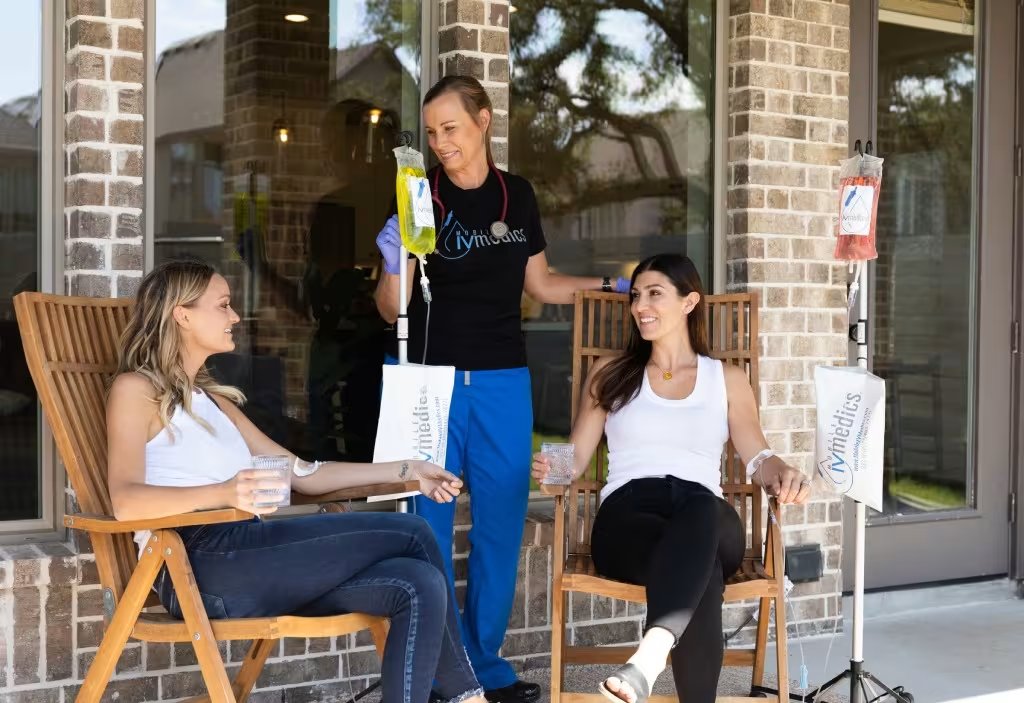
Weighed against everything the real NAD+ benefits show, IV therapy makes the most sense for people looking for medically supervised wellness or recovery support, not as a stand-in for diagnosing ongoing fatigue, cognitive changes, or other persistent symptoms. Those symptoms deserve a proper medical workup first, since NAD+ won’t fix a problem it was never designed to treat.
What NAD+ IV therapy is well suited for is someone dealing with modern lifestyle fatigue or recovery demands who wants a monitored option grounded in real mechanism, not marketing promises. Mobile IV Medics builds every NAD+ session around a nurse-administered screening and medical history review first, then lets a clinician confirm the treatment actually fits your goals before any IV goes in. Whether is NAD+ IV worth it for your specific situation is exactly the kind of question that assessment, not a guess at dosing, is built to answer.