
Key Takeaways
- There is no standard “energy drip.” Every provider mixes its own formula, so the ingredient list on one clinic’s menu tells you very little about what another clinic puts in the bag.
- Saline and electrolytes carry the strongest clinical evidence of anything in a typical bag, but oral rehydration handles mild to moderate dehydration perfectly well.
- B vitamins act as coenzymes in energy metabolism. That is a different claim from saying extra B vitamins make an already well-nourished person feel more energetic.
- B12 matters most when levels are low. If yours are already adequate, there is little evidence that more of it improves how you feel.
- Fatigue that survives sleep, fluids, and reduced stress needs a medical workup, not a repeat appointment. Knowing what each ingredient in the bag is actually studied for is what turns a purchase into a decision.
The bag hanging on the pole does not contain energy. It contains fluid, salts, and vitamins, and whether any of that helps depends entirely on why you were tired in the first place.
“Energy drip” is a menu label, not a medical formulation. Two providers can sell you something under that name and put meaningfully different things in the bag. What follows is what those ingredients actually do, and the far more useful question of whether any of them match the reason you feel drained.
Why Does Fatigue Feel Like a Hydration Problem?
Two of the connections people make here are real. Dehydration genuinely causes tiredness, and the risk climbs after heat exposure, heavy sweating, vomiting, diarrhea, or fever. Nutrient deficiencies genuinely cause fatigue too. Both B12 and magnesium deficiency list it among their presentations.
That is exactly why a bag of fluid and vitamins feels like the obvious fix for low energy. The logic holds together. Where it breaks down is coverage, because the reasons you are always tired also run through sleep debt, medication side effects, anemia, thyroid conditions, mood disorders, and chronic illness. The 3 p.m. crash that arrives every workday, or the low energy that has followed you for a month with no clear trigger, rarely traces back to one cause that an infusion can correct.

Does an Energy IV Drip Actually Work?
The honest answer depends on a prior question that most people skip, which is what is causing the fatigue in the first place. Two things get in the way of a clean yes.
Not All Fatigue Comes From Hydration or Deficiency
Fatigue is multi-causal, and the list is long. Sleep quality, medications, anemia, endocrine conditions, mood, and infection all sit on it alongside hydration and nutrient status.
If your cause sits outside those last two, no formulation resolves it. Not a bigger bag, not a more expensive add-on. The nutrients go in, get processed, and the reason you feel exhausted stays where it was.
A drip is also not a diagnostic. When fatigue survives a good week of sleep and adequate fluids, that points toward a workup rather than another appointment.
Faster Absorption Does Not Mean Better Results
IV delivery bypasses digestion and produces higher blood levels than swallowing the same nutrient. That part is true, and it is where the “100% absorption” line on clinic pages comes from.
The gap sits between higher blood levels and better outcomes. Oral and intramuscular vitamin B12 normalize B12 levels in a similar way on current evidence, and the oral route costs less. Higher concentration in the bloodstream did not translate into a better result for the patient.
Route does matter in specific situations. Impaired absorption and an inability to keep fluids down are real reasons a clinician chooses IV over oral. Those are clinical decisions tied to a person’s circumstances, not a general upgrade available to everyone.
| Oral B12 absorbs at about 1–2% in healthy adults, while IV delivery reaches close to 100% bioavailability. Bioavailability measures how much enters the bloodstream, not how much your body needs. Above your requirement, the excess is cleared in urine within 24–48 hours. |
What Is Actually in an Energy IV Drip?
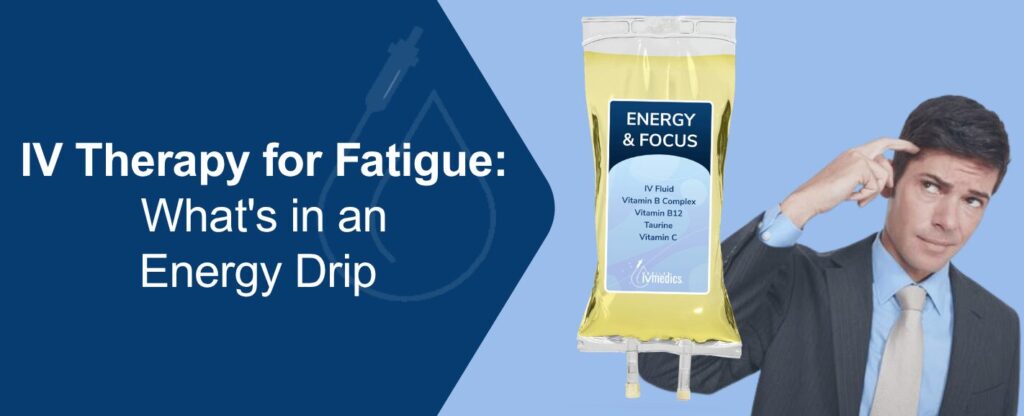
Most formulations draw from the same short list of IV drip ingredients, and each one carries a different weight of evidence. Our own Energy and Focus IV is built from 5 base components:
- IV fluids
- Vitamin C
- B-Complex
- Taurine
- Vitamin B12
NAD+, magnesium, glutathione, zinc, and extra B12 sit on the add-on menu. The pattern below repeats for every component. The nutrient is involved in some biological function, a deficiency in it can contribute to specific symptoms, and neither of those facts establishes that extra amounts help someone who already has enough.
| Ingredient | What It Does | Evidence for Fatigue |
| IV fluids, electrolytes | Restores fluid volume | Strong, when dehydration is real |
| B-Complex | Coenzymes in energy metabolism | Deficiency correction only |
| Vitamin B12 | Red blood cell and nerve function | Strong for confirmed deficiency |
| Vitamin C | Antioxidant, adrenal support | 1 trial, short-term, narrow |
| Taurine | GABA-like nervous system activity | Thin for everyday fatigue |
| NAD+, glutathione | Cellular metabolism, antioxidant | Limited for nonspecific fatigue |
Saline and Electrolytes Address Hydration
Sterile fluid plus electrolytes forms the base of almost every bag sold as an energy IV drip, and it is the component standing on the firmest ground.
Oral rehydration is the preferred route for mild to moderate dehydration. IV fluids come into play for severe cases, or when someone cannot tolerate drinking. If you are mildly dehydrated after a hot afternoon and can still drink water, water is the appropriate intervention.
Electrolyte imbalance fatigue is a genuine clinical entity, and one that needs assessment. Correcting sodium, potassium, or magnesium is a medical decision based on what a clinician finds, not something to select from a menu.
B Vitamins and B12 Support Normal Energy Metabolism
B-Complex vitamins act as coenzymes in the pathways that process carbohydrates, fats, and proteins. Accurate, and quietly where most marketing goes off the rails. “Supports energy metabolism” becomes “gives you energy” somewhere between the biochemistry and the landing page, and those are not the same statement.
Does B12 give you energy? Only in a specific circumstance.
B12 deficiency can cause fatigue and reduced exercise tolerance, because B12 is required for red blood cell formation and normal nerve function. Correcting a confirmed deficiency can improve those symptoms, sometimes substantially. If your B12 levels are already adequate, there is little evidence that adding more improves how you feel. The same logic applies to a B12 shot for energy, where the choice between IV, intramuscular, and oral depends on the cause of the deficiency rather than on which delivery method sounds strongest.
Pernicious anemia, malabsorption conditions, certain long-term medications, restrictive diets, and older age all raise the odds. Vitamin deficiency fatigue is worth taking seriously in those cases, and worth testing for rather than assuming.
Magnesium and Vitamin C Have More Specific Uses
Magnesium is required for energy production and a long list of enzyme reactions, and magnesium deficiency fatigue is documented in the clinical literature. IV magnesium sits closer to a medication than a supplement. Dose, kidney function, and the specific indication all shape whether it is appropriate.
Vitamin C has the single most interesting piece of evidence in this category. A 2012 randomized trial gave 141 healthy office workers either a single 10 g IV vitamin C infusion or a saline placebo, and the vitamin C group reported lower fatigue scores at 2 hours and again at 1 day.
Worth knowing, and worth keeping in proportion. One trial, short follow-up, a high isolated dose, a healthy adult population. It does not validate multi-ingredient blends or support any claim about how fast a drip works.
Taurine belongs in a category of its own. It is an amino acid with GABA-like activity in the nervous system, which is why it appears in formulas aimed at focus and steadier mental performance rather than raw energy output. The research on IV taurine for everyday fatigue in healthy adults is thin, and the honest framing is that it targets calm and neurotransmission rather than filling an energy deficit. If you are booking a drip specifically to feel less foggy under stress, that distinction is the one that matters.
What About NAD+ and Glutathione?
Both sit on the add-on menu rather than in the base formula, which is itself a signal worth reading. Different add-ons exist for different reasons, and that does not mean each one is proven to treat fatigue.
NAD+ is a central redox cofactor in cellular metabolism, so the mechanism connecting it to energy production is real and well established, and most of its research concerns NAD+ benefits for aging and cognition rather than everyday tiredness. Direct human evidence that IV NAD+ improves nonspecific fatigue is limited. Both statements are true at once, and the second rarely appears next to the first.
Glutathione is the body’s principal endogenous antioxidant. That is an antioxidant role, a different thing from an energy role, and not a claim about clearing toxins from your system.
Neither sits in the same evidence category as saline for dehydration or B12 for a confirmed deficiency. Knowing which category you are buying from is the point.
Which Kinds of Fatigue Respond to Fluids?
Two situations come up often enough to be worth naming, though neither is automatic.
Fluid Loss Is the Clearest Case
Prolonged vomiting, a stomach bug that has run for 2 days, heat exposure, fever, heavy exertion. What these share is real fluid loss paired with an inability to drink enough to keep up. Fluid repletion addresses a fluid deficit reasonably quickly in those situations, though how quickly depends on how depleted you were and why.
This is where a provider’s screening process matters more than its menu. At Mobile IV Medics, a physician reviews your intake and a registered nurse assesses the situation before any treatment starts, and sometimes the answer is oral fluids and a call to your doctor rather than an IV. Our Energy and Focus IV is worth booking only once you have a sense of what is driving the fatigue. That should be the standard you hold any provider to, ours included.

A Confirmed Deficiency Still Needs a Route Decision
A confirmed deficiency does not automatically point to an IV. Oral supplementation, an intramuscular injection, and dietary change are all routes a clinician may reasonably choose, depending on the cause and the severity.
Persistent fatigue may warrant testing for common causes such as anemia, B12 deficiency, or thyroid problems before assuming a nutrient IV is the answer. Testing tells you something useful even when the result comes back normal, because it rules out a branch and narrows where to look next.
Red Flags That Point Away From a Drip
Fatigue that persists through the usual ways to boost your energy, including sleep, hydration, and reduced stress, belongs in front of a physician rather than on a treatment schedule. Some combinations warrant faster attention. Fatigue alongside shortness of breath, chest pain, unexplained weight loss, fever, or fainting should prompt a medical evaluation rather than a wellness appointment.
To be direct about the boundary: a wellness IV should not be presented as a treatment for ME/CFS, long COVID, burnout, anemia, or any other underlying medical condition. Those need diagnosis and a treatment plan built around what is actually happening.
Conclusion
The useful question was never which drip sounds the most energizing. It is what might be causing the fatigue, and whether hydration or a specific nutrient need is part of that picture at all. A provider worth using will screen you before booking, tell you plainly what is in the bag, and say so when a medical evaluation makes more sense than an appointment.


