Most people assume an IV drip is just a bag of saltwater with a few vitamins thrown in. What’s actually in IV fluids determines whether you walk out feeling restored or simply well-hydrated. The difference between a hangover drip and a beauty drip isn’t the bag. It’s everything added to it.
Key Takeaways
- Every IV drip starts with a sterile saline base, the same fluid used in hospitals worldwide.
- Clinics customize each drip by adding vitamins, minerals, or medications to hit specific goals.
- Ingredient safety depends on your health history and some add-ins require medical screening.
- A transparent clinic discloses exact ingredients, doses, and pharmacy sourcing before your session.
IV therapy ingredients follow a consistent logic. A sterile fluid base sets the foundation, and a targeted layer of vitamins, minerals, or medications is built on top. Knowing what each ingredient actually does is what lets you choose the right drip for your body and your goals.
1. What Goes Into Every IV Bag No Matter Which Drip You Choose
Every IV drip, whether it’s for a hangover, a beauty boost, or simple rehydration, starts with the same base. It’s a sterile, medical-grade fluid engineered to work safely inside your bloodstream. This isn’t a wellness trend. It’s the same fluid used in hospital emergency rooms and operating rooms worldwide, and understanding why that base fluid is designed the way it is makes everything else about IV therapy make more sense.
The standard starting point is 0.9% normal saline, a sodium chloride solution with an osmolarity of about 308 mOsm/L. That number matters because it makes saline isotonic to blood plasma, meaning it won’t cause your cells to shrink or swell. Plain water can’t be given intravenously for exactly this reason. It would move rapidly into red blood cells, risking hemolysis and dangerous brain swelling. Saline keeps fluid in the vascular spaces where your circulation depends on it.
A typical session delivers 500–1,000 ml of base fluid over 30–90 minutes. Because IV fluids bypass the gut entirely, they reach your bloodstream within minutes, not the hours it takes for an oral drink to absorb. That speed is why IV rehydration often relieves dizziness, fatigue, and muscle cramps faster than drinking water, even at comparable volumes. Reputable clinics source all base fluids from licensed pharmacies, sterile, pyrogen-free, and compounded to pharmacopeia standards.
2. The Add-Ins What Clinics Put in the Bag to Hit a Specific Goal
The base fluid is consistent across every drip. What changes, and what actually drives results, is the layer of IV additives built on top of it. These are vitamins, minerals, amino acids, antioxidants, and sometimes medications, either injected into the IV bag or pushed through the same line as a separate bolus. Both methods deliver ingredients directly into the bloodstream at close to 100% bioavailability, bypassing the digestive enzymes and liver metabolism that limit how much your body actually absorbs from a pill or capsule.
That distinction matters more than most people realize. High-dose vitamin C, for example, reaches plasma levels through an IV that are simply unachievable orally, which is why certain formulas use it at therapeutic concentrations that would cause GI distress if taken as a supplement. The route of delivery isn’t just a convenience. It changes the clinical math entirely.
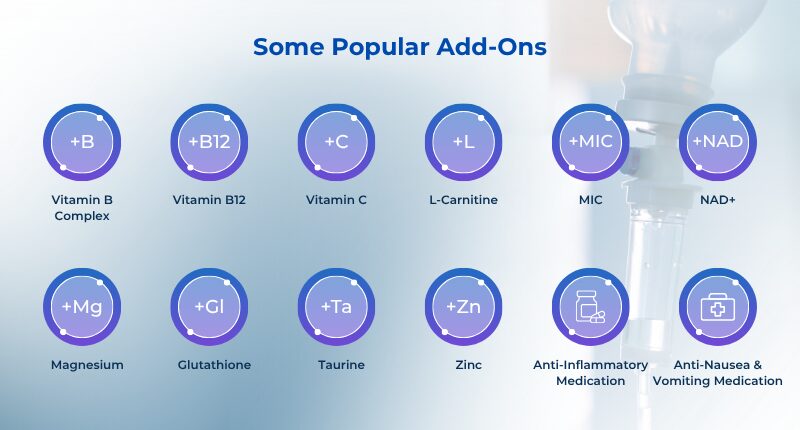
Some key add-in ingredients:
- B-complex vitamins (B1, B2, B3, B5, B6, B9) act as coenzymes in energy metabolism, ATP production, and neurotransmitter synthesis. B12 specifically supports red blood cell production and fatty acid oxidation, a core ingredient in energy, recovery, and weight loss formulas, particularly for people with absorption issues or restricted diets.
- Vitamin C supports collagen synthesis, immune cell activity, and adrenal hormone production. At IV concentrations, it also acts as a broad antioxidant, one reason it appears in hangover, beauty, and immune drips alike.
- Magnesium is a cofactor in hundreds of enzymatic reactions, including the muscle contraction-relaxation cycle. It’s central to migraine protocols, muscle recovery drips, and stress or sleep formulas, and a core component of the classic Myers’ Cocktail.
- Zinc supports immune T-cell function and is frequently bundled with vitamin C in immune-focused drips. Delivered via IV, it avoids the GI irritation that higher oral doses often cause.
- Glutathione is a tripeptide antioxidant involved in detoxification and cellular balance. It’s widely promoted in beauty drips for skin brightening, though clinical evidence for cosmetic effects is mixed. High-dose or frequent use carries real risks, including kidney dysfunction, that require qualified oversight.
- Amino acids including L-carnitine, taurine, and MIC blends (methionine, inositol, choline) appear in energy and metabolic drips. L-carnitine moves fatty acids into the mitochondria for energy production. Taurine supports cardiac function and cellular hydration. MIC blends are lipotropic agents that support the liver’s handling of dietary fat.
- NAD+ (nicotinamide adenine dinucleotide) is a coenzyme central to cellular respiration and DNA repair. It’s promoted for anti-aging and cognitive clarity, though human clinical evidence is still limited and sessions tend to be lengthy and costly.
On the medication side, ondansetron (Zofran) stops nausea fast, a key component in hangover and illness drips. Ketorolac (Toradol) is an IV non-steroidal anti-inflammatory drug used for short-term headache and body pain. Both require contraindication screening and qualified clinical supervision before use.
Dosing precision and pharmacy-grade sourcing matter as much as the ingredient list itself. Higher bioavailability means a smaller IV dose can produce stronger effects than a larger oral one, which cuts both ways.
3. What’s Actually in the Most Common IV Drips By Goal
Named drips, such as “hangover cure,” “beauty glow,” and “energy boost,” are marketing shorthand for something more specific. Each is a carefully chosen combination of IV drip ingredients, calibrated to address a particular set of symptoms or goals. Knowing what’s actually in each formula helps you evaluate whether a drip is genuinely suited to your needs, or whether it’s a generic blend dressed up with appealing language.
What’s in a Hydration IV
What is in a hydration IV comes down to a targeted electrolyte stack built on a saline or Lactated Ringer’s base, often with added potassium and magnesium to correct deficits from sweating, vomiting, or diarrhea.
Each electrolyte plays a distinct role.
- Sodium and chloride control blood volume and pressure
- Potassium regulates fluid balance inside cells and supports heart rhythm
- Magnesium keeps neuromuscular function stable throughout the body.
Oral water often falls short when electrolytes are depleted. In more extreme cases, drinking too much plain water without replacing electrolytes can dangerously dilute blood sodium, a condition called hyponatremia, with serious neurological consequences. IV fluids deliver water and electrolytes together in controlled concentrations, directly where the body needs them.
IV hydration is most appropriate when someone can’t keep fluids down, is moderately to severely dehydrated, or needs rapid restoration after heat illness or intense athletic activity. Mild dehydration usually responds well to oral rehydration solutions. Electrolyte loss tied to menstruation, heavy exercise, and acute illness also makes hydration-focused drips a common request among active adults.
What’s in a Hangover IV
A hangover isn’t a single problem. It’s 4 overlapping issues happening at once, dehydration, electrolyte imbalance, B-vitamin depletion, and inflammation. The hangover IV ingredients in a well-formulated drip target all 4 in a single session, which is what separates it from simply drinking water and taking ibuprofen.
The Myers’ Cocktail, a formulation of magnesium, calcium, B-complex, B12, and vitamin C, forms the base of many hangover and recovery protocols with additional ingredients adjusted by the provider. Because everything bypasses the stomach, relief begins within minutes rather than waiting for an irritated GI tract to process a pill.
One thing reputable clinics won’t claim is that a hangover IV detoxifies alcohol or reverses intoxication. These drips support recovery and relieve symptoms. Alcohol poisoning and alcohol dependence require a different level of medical care entirely.
| One of the earliest formalized nutrient drips, the Myers’ Cocktail has become the template for most recovery formulas. A controlled trial in fibromyalgia patients showed symptom improvements but no clear advantage over placebo, a useful reminder that rigorous evidence for IV wellness formulas is still developing. |
What’s in a Beauty or Skin Glow IV
Beauty IV drip ingredients center on a core stack of high-dose vitamin C, glutathione, biotin, B-complex vitamins, and trace minerals, each targeting a different layer of skin, hair, and nail health from the inside out.
- Vitamin C drives collagen synthesis and defends against oxidative damage from UV exposure and pollution, 2 of the primary contributors to dullness and fine lines.
- Glutathione influences melanin production pathways, which is the basis for its use in skin-brightening protocols. The clinical evidence for cosmetic glutathione effects is mixed, and some medical bodies have cautioned against unsupervised high-dose use due to potential adverse effects over time.
- Biotin and B-complex vitamins support keratin infrastructure and cellular energy metabolism, and evidence is strongest in people with an underlying deficiency, though both are routinely included regardless.
These drips work best as adjuncts to skincare, sun protection, and overall nutrition, not as standalone replacements.

What’s in a Weight Loss or Energy IV
Weight loss and energy drips share most of their ingredients, differing mainly in emphasis. A typical weight loss formula includes B12, B-complex, MIC blend (methionine, inositol, choline), L-carnitine, taurine, and a standard hydration base. Energy drips lean on the same core vitamins, B-complex, B12, magnesium, and vitamin C, but are framed around reducing fatigue and improving cognitive clarity rather than driving scale changes.
B12 and B-complex support mitochondrial ATP production and can correct fatigue tied to nutritional deficiency, which in practice helps people sustain an exercise routine more consistently. MIC blends and L-carnitine facilitate fatty acid oxidation and support the liver’s fat metabolism. Current evidence positions them as metabolic support tools, not direct fat-loss agents, and results require diet and lifestyle changes alongside them.
High-quality clinics are straightforward about this. Weight loss and energy IVs support a structured plan. They don’t replace one.
4. How IV Ingredients Are Chosen for Your Body Not Just Your Goal
Reading a drip menu and picking a formula based on your goal is a reasonable starting point, but it’s only the first layer of the decision. What actually determines whether those IV fluids and additives are safe and appropriate for you is your individual health picture, and that’s something no menu can account for on its own.
A qualified clinic starts with a full intake covering medical history, current medications, allergies, pregnancy status, and treatment goals. Some physician-led practices add lab work, including electrolytes, kidney function, B12 levels, and inflammatory markers, to calibrate dosing with greater precision. The same goal can produce entirely different formulas depending on the person. 1 client requesting an energy drip may need B-complex and hydration, another may require a magnesium-heavy migraine protocol, and a third may be unsuitable for high-dose stimulatory formulas due to an underlying heart condition.
Several ingredients have contraindications that make this level of screening non-negotiable.
- High-dose vitamin C requires caution in people with kidney disease, G6PD deficiency, or a history of kidney stones because large IV doses increase oxalate load.
- Magnesium infusions can cause low blood pressure, slowed heart rate, or respiratory depression if overdosed or given to patients with cardiac or renal impairment.
- Ketorolac can worsen kidney function, trigger GI bleeding, or interact dangerously with anticoagulants.
- High fluid volumes, particularly above 1 liter or delivered rapidly, can worsen heart failure and pulmonary edema in vulnerable patients.
Pregnant patients, those on multiple chronic medications, and people managing autoimmune or immunosuppressive conditions all need individualized ingredient choices to avoid harmful interactions. Physician-led clinics typically enforce standardized screening protocols and maintain nursing supervision throughout the infusion. Mobile and lounge-style providers vary widely in how rigorously these standards are applied, which is worth factoring into your decision.
5. What to Ask and Watch For Before You Book an IV Drip
The quality of an IV session isn’t just about the ingredients on the menu. It’s about what happens before the needle goes in. A clinic’s willingness to be transparent about its sourcing, screening process, and staff credentials tells you more about safety than any drip name ever will.
Reputable providers disclose exact IV solution ingredients and doses, for example “B-complex 1 ml, vitamin C 2 g, magnesium 200 mg, glutathione 600 mg in 500 ml normal saline,” and explain the clinical rationale for each one. Vague descriptions like “proprietary detox blend” or “super immune formula” without a full ingredient list make it impossible for you or your doctor to assess whether the formula is safe for your profile. Before booking, make sure you get clear answers to these questions.
- What is in this IV bag and at what doses?
- Are the vitamins and medications sourced from a licensed compounding pharmacy?
- Who is administering the drip and what are their medical credentials?
- What screening is performed for kidney disease, heart conditions, current medications, or pregnancy?
- What side effects should you watch for during and after the session?
Walk away from any clinic with no medical intake process, staff who can’t explain each ingredient’s purpose, or claims that IV therapy can cure serious illness. The absence of documented pharmacy sourcing, sterility standards, or on-site emergency protocols is also a serious concern.
Physician clearance is recommended before any elective wellness IV for people with kidney disease, heart failure, uncontrolled hypertension, significant liver disease, or bleeding disorders, as well as anyone on anticoagulants or managing multiple chronic conditions. Pregnant and breastfeeding individuals should only receive IV infusions under direct medical guidance, particularly when medications like ondansetron or ketorolac are involved.

Every IV drip is built on the same sterile fluid base, and what separates 1 formula from another is the specific combination of iv therapy ingredients layered on top. Understanding what goes into IV fluids, what each component does, and whether it’s right for your body is the most important step before booking a session. Mobile IV Medics delivers medically supervised IV therapy with full ingredient transparency, qualified clinical staff, and personalized intake screening across the country.