
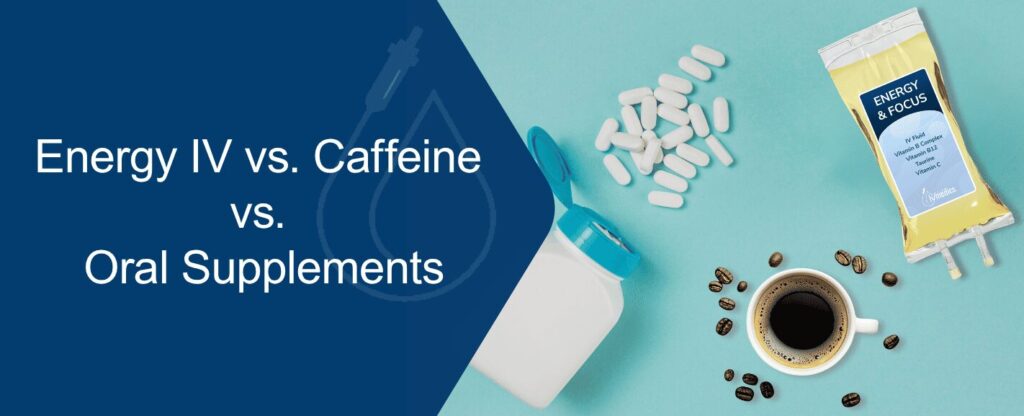
Key Takeaways
- Energy IVs, caffeine, and oral supplements work differently, so the better option depends on why you feel tired rather than which one sounds strongest.
- Caffeine can temporarily increase alertness, but it does not correct dehydration, nutrient deficiency, or insufficient sleep.
- Oral supplements may help when they address a relevant nutrient deficiency, but they are not reliably shown to increase energy when nutrient levels are already adequate.
- IV delivery puts fluids and nutrients directly into the bloodstream, but faster delivery does not automatically mean a better fatigue outcome.
- Fatigue that does not improve after 2 or more weeks of adequate rest, nutrition, hydration, and stress reduction should be evaluated by a healthcare professional.
Hook
It is 2 PM, you are flattened, and 3 options look interchangeable: another coffee, a bottle of B12, or a booked infusion. Most people frame it as energy IV vs caffeine and pick whichever one sounds strongest.
Introduction
The energy IV vs caffeine comparison comes up constantly, usually alongside a third option the person already has in a cabinet at home. Energy IVs, caffeine, and supplements are not three versions of the same energy boost. They act on different systems, so the better choice depends on why you feel tired in the first place.
How Do Energy IVs, Caffeine, and Supplements Differ?
The energy IV vs caffeine framing makes the three sound like competitors on a single axis of strength. Put side by side, they differ less in power than in target. One changes a signal in the brain, one restocks a specific nutrient, one replaces fluid and nutrients through a vein.
| Attribute | Caffeine | Oral supplements | Energy IV |
| How it acts | Blocks the adenosine receptors that signal sleepiness | Restocks a specific nutrient through digestion | Delivers fluid and micronutrients through a vein |
| What it targets | Alertness, not the reason for the tiredness | A deficiency you have measured | Fluid volume and nutrient levels |
| Timing | Peaks around 45 minutes in saliva and 2 hours in serum, half-life 3–7 hours | Does not act quickly | Reaches the bloodstream during the infusion, with no reliable duration figure |
| What it cannot do | Replace fluid, iron, B12, or sleep | Raise energy when levels are already normal | Guarantee a better fatigue outcome |
Caffeine Boosts Alertness Without Correcting Why You’re Tired
Adenosine builds up across a waking day and creates the pressure you register as sleepiness. Caffeine blocks the receptors adenosine binds to, so the pressure stops reaching you while it keeps accumulating underneath. Concentration peaks in saliva around 45 minutes after a drink and in serum around 2 hours, with an adult half-life that usually runs 3–7 hours and shifts with genetics, smoking, pregnancy, and medication.
Regular use adds a wrinkle. Chronic intake changes adenosine signaling, and withdrawal brings headache, drowsiness, fatigue, and low mood, so a heavy coffee drinker’s morning lift may be withdrawal clearing rather than something gained. Most healthy adults can take 400 mg a day without dangerous effects, and the word most is carrying weight in that sentence. Pregnancy, arrhythmia risk, anxiety, and drug interactions all move the line.
Oral Vitamins Can Help When They Correct a Deficiency
The strongest evidence here is narrow and specific. People who are genuinely low on iron do feel less tired once they correct it, and that holds even for those who have not tipped into anemia yet.
| In the same research, people said they felt less tired, but their actual physical performance did not improve. Correcting a shortfall can change how you feel without making you measurably stronger. Those are two different results, and only one of them shows up on a test. |
Vitamin B12 tells a similar story. Running low causes fatigue, weakness, and a specific kind of anemia, and correcting it helps, but B12 is not an energy booster for someone whose levels are already normal. That distinction sorts the energy vitamins worth taking from the rest, caffeine free energy supplements included. They are a reasonable option when they address something you have measured, and close to guesswork when they do not. Taking too much has its own price: iron poisoning, nerve damage from years of high-dose B6, and uncomfortable skin flushing from large amounts of niacin.
Energy IVs Deliver Fluids and Nutrients Directly
An energy IV therapy session puts fluid and micronutrients into the bloodstream through a vein, skipping gastrointestinal absorption entirely. That is a pharmacology fact and worth stating plainly. IV vitamins for energy usually combine fluid volume with B-complex or B12 and magnesium, with the exact mix varying by provider.
What the delivery route does not do is settle the outcome question. Vitamins given through a vein have real medical uses when someone is deficient, cannot absorb nutrients through the gut, or is badly dehydrated, but the wellness case stays unproven in healthy people, with evidence that is limited and largely anecdotal. Anyone searching for the best IV drip for energy deserves that sentence before a price list.

Faster Delivery Does Not Guarantee Better Energy Outcomes
Most versions of the energy IV vs oral supplements argument turn on how much your body actually absorbs. Skipping digestion does put more of a nutrient into your blood, faster. Whether that changes how you feel is a separate question, and the clearest test of it gave a full dose of iron straight into the vein to people whose iron stores had run down.
Half of them got the iron and half got nothing active, and neither group ended up with more energy than the other. Getting more in, faster, did not make anyone feel better. That is the part of the difference between IV therapy and supplements that most comparisons get backwards. Route affects speed and absorption reliability, while cause determines whether anything improves at all.
The Right Option Depends on Why You Feel Tired
Tiredness is a symptom, not a diagnosis, and why you are always tired is rarely one single thing. Documented causes of fatigue include:
- Insufficient sleep
- Medication effects
- Depression and anxiety
- Anemia
- Thyroid disease
- Sleep apnea
- Infection
- Heart or kidney disease
A stimulant addresses none of those. A nutrient addresses a few, and only when it happens to be the missing one. Which reframes the whole comparison. Asking which of the three is strongest has no answer. Asking which one matches the reason you are tired has one, and sometimes that answer is none of them yet.

When Might an Energy IV Make Sense?
There is a defensible lane for IV therapy for fatigue, and it is narrower than most marketing suggests. The conditions that make an infusion appropriate are clinical conditions, not mood states.
IV Fluids May Help When Oral Hydration Is Not Enough
The line gets drawn at severity and ability. IV fluids are reserved for severe dehydration, shock, uncontrolled vomiting, or a person too depleted to drink at all. Drinking water takes over from an IV as soon as it is tolerated. If you can drink, drinking is usually the right first move, which is worth saying even when it costs us an IV hydration visit.
The sequence that protects you is symptom, then clinical assessment, then route. Not symptom, then infusion. Mobile IV Medics registered nurses assess before treating and decline when an IV is not indicated, and that step is worth checking when you vet any provider.
| A symptom list is not an indication. Any provider who books an infusion straight from your description, without a clinician assessing whether an IV is warranted, has removed the step that exists to protect you. Ask who performs that assessment before booking. |
Nutrient Delivery May Matter in Specific Clinical Situations
A gut that cannot absorb properly, a stomach that cannot keep anything down, and a shortfall a clinician has actually measured are the situations where the delivery route genuinely matters. Outside those, the evidence thins fast.
The research most often quoted in favor of energy infusions gave a vitamin drip to 7 people with hard-to-treat fibromyalgia once a week for 8 weeks, and they reported less pain and fatigue afterward. Seven people is not enough to build a claim on. Nobody was compared against an untreated group, everyone already had the same condition, and the bag held so many ingredients that there is no way to tell which one mattered, if any did. No reliable figure exists for how long an IV energy boost is supposed to last, either.
How Should You Choose Between the Three?
These 5 situations cover most of what sends people to this comparison.
| Situation | Caffeine | Oral supplement | Energy IV |
| Short-term alertness on an ordinary day | Most directly relevant | Does not act quickly | Not a stimulant |
| Mild dehydration, still able to drink | Not the right tool | Not the right tool | Oral fluids come first |
| Cannot keep fluids down at all | Does not apply | Does not apply | Clinical assessment for IV fluids is reasonable |
| Nutrient deficiency confirmed by testing | Does nothing for it | Often appropriate, depending on the nutrient | Appropriate in selected situations a clinician identifies |
| Persistent unexplained fatigue | May mask it | Guessing at a deficiency you never measured | Belongs after a diagnosis, not instead of one |
The same thread runs through all 5. Start with the cause, not the delivery method. Choosing between IV therapy or supplements is a question you cannot answer until you know what you are trying to correct.
When Is Low Energy a Medical Concern?
The threshold worth remembering is 2 weeks. Fatigue that outlasts 2 weeks of adequate sleep, food, fluids, and reduced stress is worth bringing to a clinician, and that window exists because self-treatment past it starts delaying diagnosis rather than solving anything.
Some symptoms do not wait for the window. Alongside fatigue, any of these point to the ER rather than an infusion:
- Chest pain
- Shortness of breath
- A rapid or irregular heartbeat
- Faintness
- Unusual bleeding
- Severe pain or headache
Depending on your symptoms and history, a clinician may consider bloodwork for issues such as anemia, iron or B12 deficiency, or thyroid problems. That is a conversation to have with them, not a panel to request off a blog post.
A few groups should be more careful with all 3 options:
- Anyone pregnant
- Anyone with arrhythmia risk or kidney disease
- Anyone taking anticoagulants
- Anyone already on a stack of supplements where interactions get hard to track
None of the three replaces sleep, food, or a medical evaluation.
Conclusion
The energy IV vs caffeine debate resolves the moment you stop asking which option is strongest and start asking what is actually draining you. Get that answered first. The choice after that tends to make itself, and sometimes it is none of the three.


